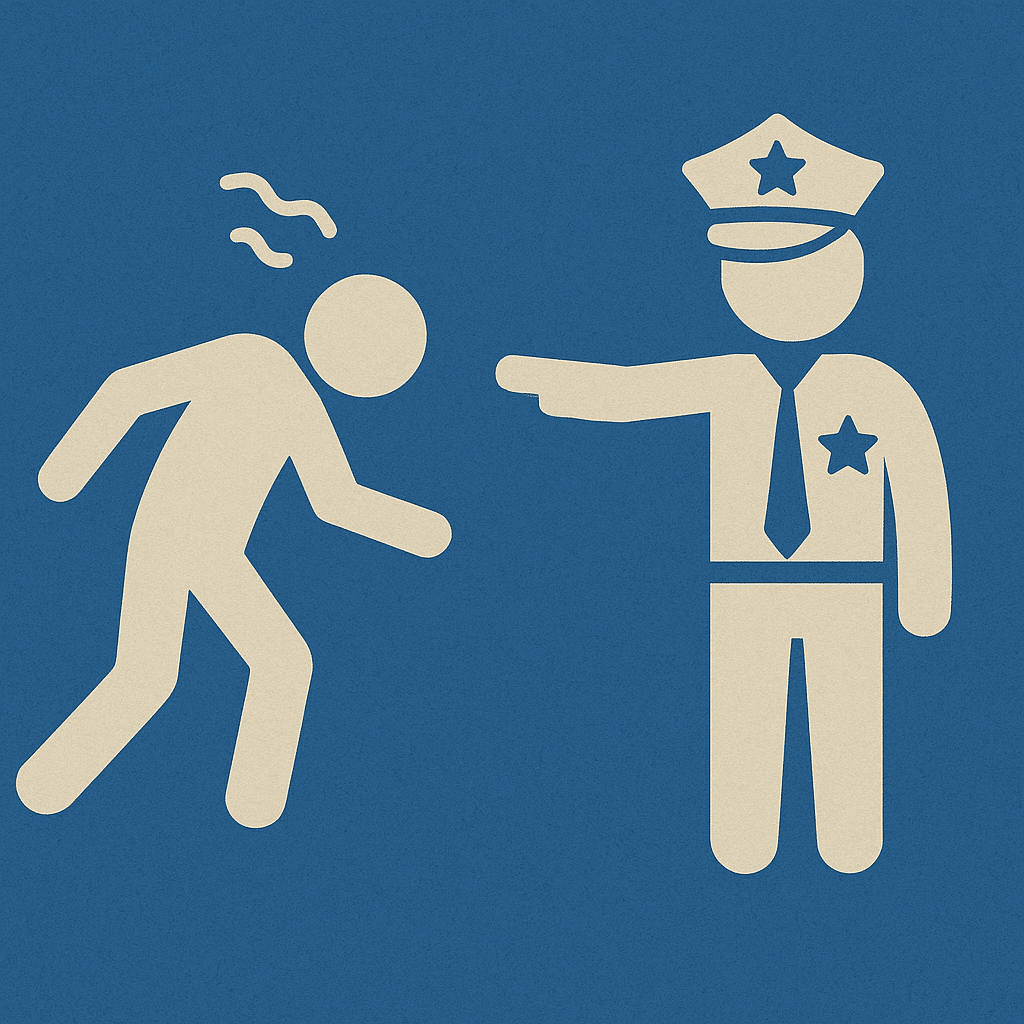
Disorderly conduct charges in Maryland are among the most common misdemeanors filed in District Court, and among the most loosely applied. Police reach for the charge after bar fights, loud arguments in parking lots, protests, and tense roadside encounters, often when no other offense clearly fits. The statute is narrower than the way it gets used, and that gap is where many of these cases are won or lost.
What Maryland’s disorderly conduct law prohibits
Disorderly conduct is defined in Criminal Law § 10-201, which Maryland titles “disturbing the public peace and disorderly conduct.” The statute makes it a crime to:
- willfully and without a lawful purpose obstruct or hinder another person’s free passage in a public place or on public transportation;
- willfully act in a disorderly manner that disturbs the public peace;
- willfully fail to obey a reasonable and lawful order of a police officer that was made to prevent a disturbance to the public peace; or
- willfully disturb another person’s peace with unreasonably loud noise, whether on that person’s property, in a public place, or on public transportation.
Every version of the offense turns on the public peace. The law protects the public’s right to be left alone. It does not make it a crime to annoy, argue with, or embarrass a police officer.
Penalties for disorderly conduct
Disorderly conduct is a misdemeanor. A conviction carries up to 60 days in jail, a fine of up to $500, or both (§ 10-201(d)).
Because the maximum sentence is under 90 days, a disorderly conduct charge on its own is tried by a judge in District Court, and you cannot pray a jury trial to move it to Circuit Court. We explain how that works in Understanding a Jury Trial Prayer in Maryland.
The bigger cost is usually the record and the company the charge keeps. Disorderly conduct is often stacked with resisting arrest, assault on a police officer, or public intoxication. A conviction also shows up on Maryland Judiciary Case Search, where employers and landlords can see it.
Where these charges come from
Most disorderly conduct cases in Southern Maryland grow out of a handful of situations:
- disputes outside bars and restaurants at closing time;
- domestic arguments that spill into a yard, a hallway, or a parking lot;
- traffic stops where a driver or passenger argues with the officer;
- protests, school events, and sporting events; and
- noise complaints at apartments and townhomes.
In many of these cases the only witness is the arresting officer, and the charging document describes the “disturbance” in a sentence or two.
Defenses that matter
No disturbance of the public peace. The State has to prove that the conduct actually disturbed the public, not just the officer. In Diehl v. State, 294 Md. 466 (1982), Maryland’s highest court reversed the disorderly conduct conviction of a passenger who shouted at an officer after being ordered back into a car. The court found his words were an emotional reaction, not an attempt to provoke violence, and that the order itself was unlawful. Who was there, what they did, and whether anyone was actually disturbed are fact questions the State often cannot answer.
The order was not lawful, or was not about the peace. A failure-to-obey charge requires an order that was reasonable, lawful, and made to prevent a disturbance. An order to stop recording, to stop asking questions, or to leave a place you have a right to be may not qualify.
Protected speech. Criticism of police, even loud criticism, is protected by the First Amendment unless it crosses into threats or words likely to provoke an immediate fight.
Not willful, or not public. The statute requires willful conduct, and most prongs require a public place or another person’s disturbed peace. A private argument inside a home is a different case than one in a crowded parking lot.
The video. Body camera and dashcam footage frequently tells a calmer story than the report. We cover how that evidence is obtained and used in How Body Camera and Dashcam Footage Can Help Your Criminal Case.
Outcomes short of a conviction
Many disorderly conduct cases resolve without a conviction. Depending on the facts and your record, options can include a dismissal, a stet, or probation before judgment. If a case ends in an acquittal, dismissal, or nolle prosequi, the record can generally be expunged. A disorderly conduct conviction is also among the convictions Maryland allows to be expunged after a waiting period under Criminal Procedure § 10-110. Our expungement page explains the process.
Why it helps to have a former prosecutor on your side
Jeremy Widder spent nine years as a prosecutor in Charles County, and he has charged and tried these cases from the State’s side. He knows how thin a disorderly conduct file can be when it rests on one officer’s description of a crowd that was supposedly “disturbed,” and he knows what a prosecutor needs to see before agreeing to dismiss. Disorderly conduct is one of the minor offenses we handle every week; see our protective orders and minor offenses practice area.
Charged with disorderly conduct in Southern Maryland?
If you have been charged with disorderly conduct in Prince George’s, Charles, Calvert, or St. Mary’s County, talk to a lawyer before your first court date. Contact SoMD Criminal Defense for a free consultation.